
The Miyawaki method
The book I am about to review (Mini-Forest Revolution by Hannah Lewis) isn’t my first encounter with the late Dr. Akira Miyawaki’s method. I had heard about it online and in magazines but I didn’t dig deeper because I’m a busy guy.
Then, a few weeks ago, I picked up my Sunday New York Times and the only positive story in that issue was about a successful Miyawaki forest planted in a 40×40 foot plot right inside a New Jersey community garden. So I went on Amazon and purchased the one recommended book written by Hannah Lewis. This is my review.
Award-winning primer
Hannah Lewis’s book is a great primer on the Miyawaki method. She gives you the background, introduces you to projects from around the world, gives you the steps you must take and finishes with her own mini-forest from France. Notes, resources and further reading are included. It’s a nice, tight book that fully deserves the prize it received.
Miyawaki’s brilliant ideas!
I’m not surprised that a Japanese plant ecologist devised his own method for rapidly creating mini-forests on small plots. The key is speeding up the plant succession process. In nature, a bare plot will get first colonized by weeds, then small shrubs move in, followed by fast-growing trees that eventually get outcompeted by climax tree species.
Miyawaki skipped straight to the climax forest by planting trees and shrubs native to the area.
And the other important feature of Miyawaki’s Method is tight planting. As soon as I read that I thought about plant death from competition but it’s not an issue! Allegedly.
So, once you identify a suitable small plot, assemble a team and get funding, the craziest part is identifying and sourcing native plants to put into your plot. Now, in Japan, Dr. Miyawaki was sneaky; he visited the nearest temples and shrines where trees go unmolested for centuries and identified the plant species thriving there.
Planting
Planting is the best part but before planting the plot’s soil is mulched and aerated. depending on its condition. Your forest will do well, if the soil is improved.
For planting day you get kids and volunteers involved; Miyawaki even had planting ceremonies where kids would introduce every single species to be planted by saying its name three times.
Once the plants are in the ground, it takes three years before the mini-forest becomes self-sufficient. Which means the trees must be watered, the forest must be weeded and thrash removed. In some projects, fences were put up to keep animals from eating the new plants.
Miyawaki magic
And just like that, in about three years you can establish a mini-forest on a plot that used to be an abandoned parking lot or a no-man’s land parcel behind your local mall.
Now kids can play in the forest, animals move in, trees cool the neighbourhood and suck up carbon. The benefits are many.
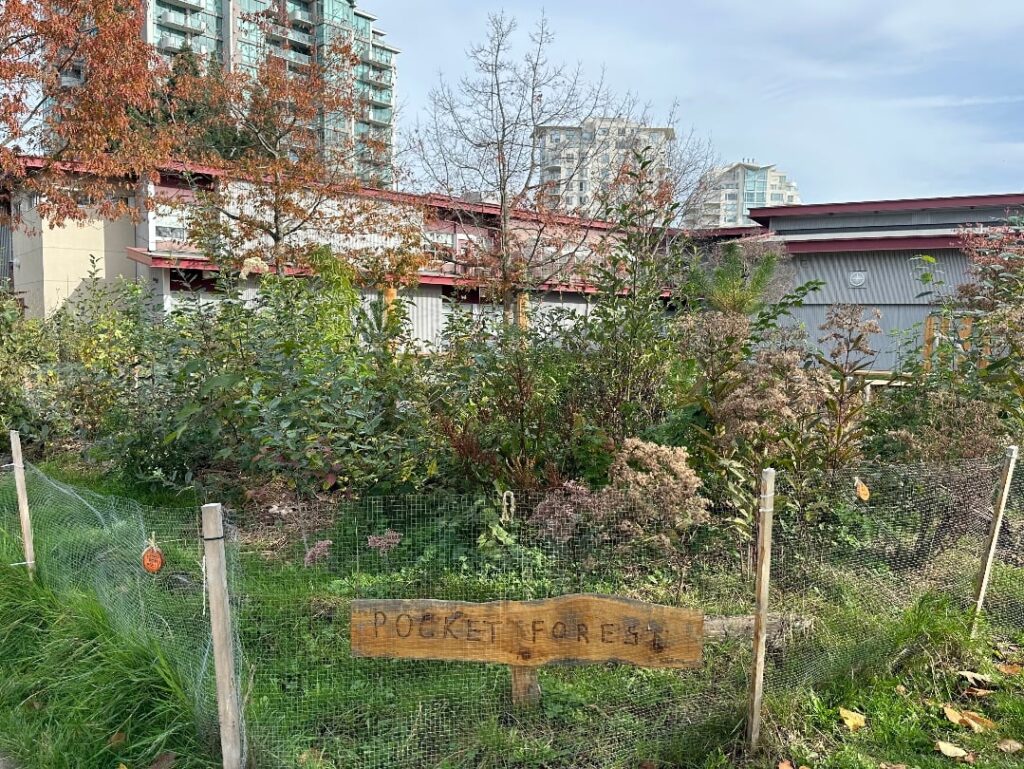
I did a quick Google search in my home province of British Columbia and the nearest Miyawaki mini-forest is about a 45 minute drive away. My plan is to visit the forest, planted in 2022, and see if I can identify the native species that were planted there. That will be a future blog post.
Conclusion
If you want a nice introduction to the Miyawaki method for creating mini-forests, this book is an excellent choice. Why not rewild a small plot in your neighbourhood?
