
Another sad hedge
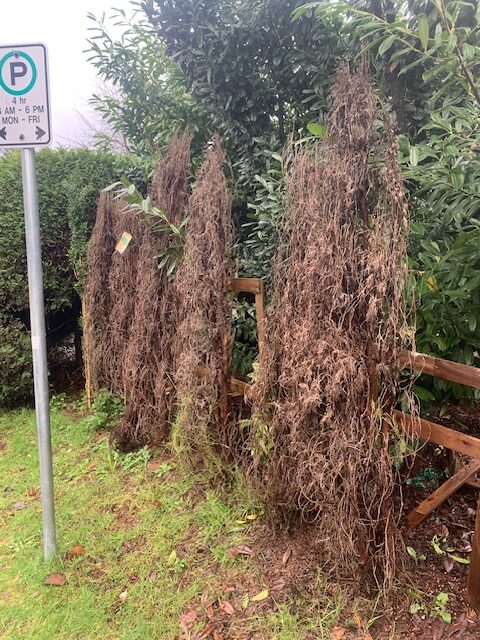
Sometimes I drive a bigger truck, which means I have to park a few blocks away from my place. And when I parked there recently, I noticed a really sad-looking cedar hedge. The line of Emerald cedars (Thuja occidentalis) was mostly dead, there was no obvious separation between the hedge and lawn, and there was a massive laurel specimen towering over the hedge.
And, unfortunately, I see this a lot. With the climate changing, our summers are getting hotter. And that means that planting a new cedar hedge to replace this dead one is a sketchy project. It’s so hard to establish these new cedar hedges that we openly suggest alternatives to clients. For example, we find that the glossy Portuguese laurels (Prunus lusitanica) do much better in the heat once they get established. They can be sheared and eventually form a nice hedge, even if it isn’t as solid as a cedar hedge.
Help your baby hedge
If you do decide to replant with cedar hedges, you will save some cash because cedars are cheaper than available alternatives. But, you’re taking a chance.
Your new hedge will require frequent watering, even in winter. The hot summer window is obviously a critical time for your hedge. I replaced four cedars for a client in the fall, and they looked great in early summer. Then, by early fall, I was noticing some browning. And now, in early 2026, they’re dead, and I will replace them in spring.
I recommend planting in the fall, so the plants have some time to establish before summer comes. Spring planting means that I will have to baby the new cedars. Of course, it didn’t help that my client has an autoimmune disease, which doesn’t allow him to be out in direct sunlight. He can’t water, and I’m too busy to come do it weekly.
Incidentally, this kind of client is gold because you know he can’t be out in the garden. He needs your services; and you need to feed your kids. It works well.
Let’s do this
I buy cedars in plastic pots, so I don’t have to worry about burlap and whether or not I should keep it on or off. I hate putting burlap into planting holes. Add some water to your planting holes and then put the trees in.
Treat the planting like trees. Backfill the lowest third of the hole with the original native soil and tamp it down, then backfill the second third and repeat. If you top dress with new soil on the surface, make sure it’s not too hot from the supplier. Put it between the plants, but don’t pile it against the stems. That could rot the wood and invite diseases in.
Take a good look at your planting area. If you see obvious sources of shading, try to eliminate or limit them. Cedars need light.
Don’t forget to slow soak your new plants and check on them frequently. They need water, but don’t suffocate them by over-watering. Good luck to them!
Why not take a break from reading by checking out my YouTube channel. Leave me comments, likes, and don’t forget to subscribe!