
This is new!
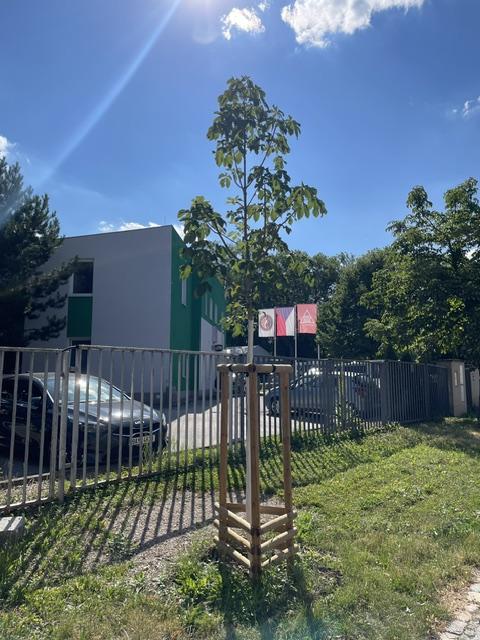
Roughly a week into my visit to Prague, Czechia, I walked my son to a soccer club for tryouts. First we passed by an old pond with very old willow trees, and I got stopped in my tracks by a young horse chestnut tree (Aesculus hippocastanum).
I know the trees well, with their spiky seed covers hiding the chest nuts inside. What I noticed was the triangular tree stake construction, and fairly tight arbor ties. Also, the tree trunk was covered in white up to the crown.
So I snapped a few photos and continued walking, making a mental note to look things up at home. Back home in Canada we don’t apply anyhting to the trunk of new trees.
Then I got busy and distracted.
Fous to the rescue
Ondrej Fous is a local Prague gardener I know from his webpages, his Echo magazine artciles and from his new Czech-language book “Lodyhy”. Now, it’s obvious that white coating on a young tree trunk is there for protection, not adornment. It prevents bark damage from high temperatures and frost. It’s usually applied on young trees after planting, like this Aesculus.
But I had to ask what exactly it was so I could look it up.
People used to apply lime to young tree trunks for winter protection but it performed poorly, and required two coatings. It also didn’t offer any summer protection.
Arbo-flex is a thick, pasty product, that’s applied to trees in undiluted form. It lasts up to five years, which replaces ten to fifteen lime coatings. It’s also elastic so it doesn’t inhibit growth.
How to do it
According to my online search, there are three steps involved in applying Arbo-flex. First, the trunk is cleaned with brushes. Second, a primer is applied to the cleaned trunk. And lastly, the white, pasty Arbo-flex is applied to dry bark, when temperatures are above ten degrees Celsius.
Now I want to see some stats on how effective this treatment is. If you travel in Europe and see white paint on trees, you’ll know what is happening.
Merchandise from WCLP